
AI serves human governance.
In official operations, an AI system is only as trustworthy as the accountability around it. Vinkura builds AI that augments official judgement, keeps a human responsible, and makes every consequential decision reviewable.
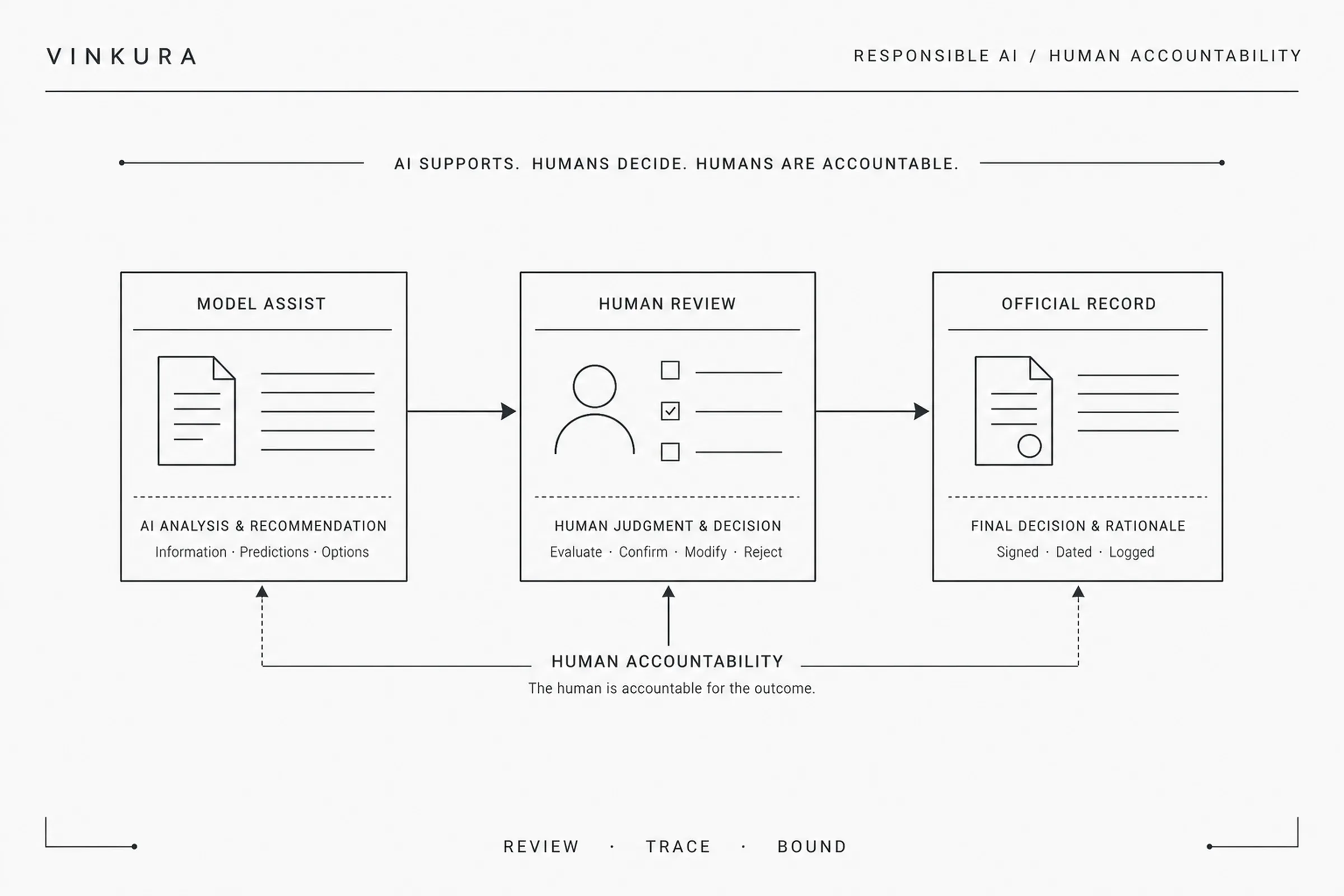
AI remains a tool for human governance and accountability, not a replacement for it. Where a decision affects a citizen, an officer, or an outcome of consequence, a person remains responsible.
Human accountability
AI supports official judgement; it does not replace it. Every consequential action retains a human decision-maker who is responsible and answerable.
Traceability
Model-assisted outputs are attributable and reviewable. Operators can see what informed a recommendation and reconstruct how a decision was reached.
Bounded autonomy
Automation operates inside explicit, scoped limits. Systems act within defined authority and escalate to humans when confidence or scope is exceeded.
Data minimization
Models are given the least data required for the task. Access is role-scoped, purpose-bound, and aligned to DPDP expectations.
Fairness & review
Deployments are evaluated for context-appropriate behaviour, with mechanisms to review outputs and correct systematic error over time.
Sovereign control
The engaging institution retains ownership and control of its data and the operational boundaries within which models run.
How this shows up in practice.
Responsible AI is not a statement; it is a set of controls wired into how our platform is deployed and operated inside institutions.
- Human-in-the-loop review on consequential actions
- Attributable, reviewable decision trails
- Scoped model access and role-based permissions
- Configurable escalation and override paths
- Institution-owned data and deployment boundaries
Discuss governance & oversight
Talk to our team about human oversight, review workflows, and accountability controls for AI in your operations.