

Executive Summary
Modern state police departments, internal security directorates, and intelligence agencies across India operate in an environment of critical informational fragmentation. Investigative teams routinely maintain segregated databases across Crime and Criminal Tracking Network & Systems (CCTNS), Inter-operable Criminal Justice System (ICJS), telecom Call Detail Record (CDR/IPDR) repositories, vehicle registry databases (VAHAN/SARATHI), automated biometric archives, and field duty rosters.
When N public safety and intelligence agencies attempt point-to-point data ingestion, they generate O(N²) brittle ETL pipelines. Without a shared semantic ontology, records lack relational context, cross-departmental clearances cannot be enforced cryptographically, and institutional memory dissolves into isolated operational islands.
Attempts to resolve this through centralized commercial data lakes create severe vulnerabilities: either data is indiscriminately pooled—violating strict statutory compartmentalization and chain of custody—or departments refuse to share intelligence due to lack of tamper-evident access controls.
Vinkura Core & AEGIS resolve this paradox by replacing monolithic warehouses with a Federated Graph Ontology with Air-Gapped Zero-Trust Governance. Every operational asset—from an FIR narrative and physical firearm exhibit to an IMSI tracker and magistrate warrant—is modeled within a unified mathematical graph where access is governed at query-time through multi-attribute cryptographic validation.
1. Sovereign Architecture vs. Foreign Commercial SaaS
National institutions frequently evaluate commercial cloud platforms (such as Palantir Gotham/Foundry, Microsoft Azure Government, or AWS Secret Region). However, foreign-headquartered platforms introduce severe jurisdictional, operational, and cryptographic vulnerabilities under international law:
Extraterritorial CLOUD Act Compulsion
Under the United States Clarifying Lawful Overseas Use of Data (CLOUD) Act (18 U.S.C. § 2713) and FISA 702, foreign commercial vendors can be compelled by foreign courts to disclose data or access vectors stored on their systems, irrespective of where data centers physically reside.
Telemetry Channels & Kill-Switches
Commercial SaaS platforms require periodic licensing pings, telemetry heartbeats, and proprietary model updates over public internet endpoints. In the event of geopolitical sanctions, remote license revocation or telemetry disruption paralyzes domestic command systems.
Comparative Architecture Matrix
| Architectural Dimension | Foreign SaaS / Cloud Intelligence | Vinkura Core & AEGIS Sovereign Platform |
|---|---|---|
| Jurisdictional Sovereignty | Subject to foreign subpoenas, CLOUD Act & FISA warrants | 100% Indian Jurisdiction; zero foreign legal entanglement |
| Physical Air-Gap Isolation | Requires persistent or periodic cloud internet ingress/egress | True physical air-gap; zero outbound packets; RF-silent capability |
| Cryptographic Root of Trust | Vendor-managed KMS keys; opaque cloud hardware enclave | Sovereign HSM ownership; Ed25519 officer identity hardware tokens |
| Inter-Agency Clearances | Coarse-grained role permissions; multi-tenant sharing risks | Dynamic Attribute-Based Access Control (ABAC) on every graph edge |
| DDIL Edge Synchronization | Fragile over low bandwidth; fails during RF jamming/blackouts | Dhava Sync Engine; Vector-clock CRDTs over VHF, satellite & sneakernet |
| Auditability & Chain of Custody | Internal vendor audit logs modifiable by system administrators | Append-only cryptographic Merkle DAG with non-repudiable actor signatures |
2. Tri-Graph Core Architecture
At the heart of Vinkura Core is the Tri-Graph Engine, which models sovereign operations across three intersecting, cryptographically coupled graph topologies:
- 1. Identity Clearance Graph (G_IC): Models organizational hierarchy, statutory powers, security clearances, dynamic warrant bindings, and active jurisdiction polygons for officers across departments.
- 2. Relational Entity Graph (G_RE): Unifies physical entities, events, telecommunication vectors, vehicles, financial accounts, and investigative records into an encrypted property graph.
- 3. Cryptographic Audit Ledger (G_AL): A tamper-evident Merkle Directed Acyclic Graph (DAG) recording every graph read, traversal, correlation, and export event with hardware-timestamped digital signatures.
3. Federated ABAC & Dynamic Warrant Clearances
Traditional Role-Based Access Control (RBAC) is brittle in inter-agency operations: assigning static permissions either leaks sensitive intelligence or creates operational paralysis during multi-jurisdictional emergencies.
Vinkura Core introduces Dynamic Warrant-Gated Traversal. When an investigator executes an exploratory path search across suspects, vehicles, or phone numbers:
- Sub-Graph Ephemeral Encryption: Attributes matching restricted compartments (e.g., narcotics wiretaps or confidential informants) are encrypted with compartmental public keys.
- Automated Dual-Key Quarantine:If a traversal intersects another department's active case, the engine surfaces an anonymous cryptographic collision token without revealing the underlying subject identity.
- Magistrate Digital Warrant Binding: Extended 3-hop and 4-hop link analysis requires attaching a cryptographically signed electronic warrant ID, which automatically limits the query lifetime to the statutory investigation window.
4. DDIL Event-Driven Sync Engine (Dhava Integration)
Tactical deployments—such as forward operating base surveillance, border checkpoint inspection, or disaster response fleets—frequently operate under Denied, Disrupted, Intermittent, and Limited (DDIL) bandwidth conditions.
Vinkura Core embeds the indigenous Dhava Tactical Sync Engine, which replaces fragile client-server database replication with offline-first deterministic vector clocks and binary wire framing:
5. Formal Mathematical Ontology & Schemas
The production Tri-Graph schema formalizes all multi-agency relations into strongly typed, cryptographically verifiable definitions:
/**
 * Vinkura Core Sovereign Tri-Graph Specification
 * Standard: VK-ONTOLOGY-v4.2 (Production Air-Gapped Release)
 */

export type SecurityLevel = 'UNCLASSIFIED' | 'RESTRICTED' | 'CONFIDENTIAL' | 'SECRET' | 'TOP_SECRET';

export type IntelligenceCompartment =
  | 'COUNTER_TERRORISM'
  | 'NARCOTICS_INTERDICTION'
  | 'ORGANIZED_CRIME'
  | 'FINANCIAL_INTELLIGENCE'
  | 'INTERNAL_VIGILANCE';

export interface IdentityClearanceNode {
  officerId: string; // Unique Sovereign ID (e.g., POL-IN-MH-9921)
  publicKeyEd25519: string; // Hardware Token Public Key
  securityLevel: SecurityLevel;
  compartments: IntelligenceCompartment[];
  jurisdictionGeofenceGeoJSON: string;
  activeWarrantId?: string;
  warrantValidUntil?: string; // ISO 8601 UTC
}

export interface RelationalEntityNode {
  entityId: string; // Canonical SHA-256 Hash
  entityType: 'PERSON' | 'VEHICLE' | 'IMEI_IMSI' | 'BANK_ACCOUNT' | 'FIREARM' | 'FIR_CASE';
  classification: SecurityLevel;
  owningDepartment: string;
  attributesEncrypted: Record<string, string>; // AES-256-GCM field ciphertext
  redactionMask: string[];
}

export interface RelationalEdge {
  sourceEntityId: string;
  targetEntityId: string;
  relationType: 'COMMUNICATED_WITH' | 'CO_LOCATED_AT' | 'REGISTERED_OWNER' | 'TRANSFERRED_FUNDS' | 'SEIZED_IN_CASE';
  confidenceScore: number; // 0.00 to 1.00
  firstObservedTimestamp: number;
  lastObservedTimestamp: number;
  evidenceSourceId: string;
}

export interface CryptographicAuditReceipt {
  transactionId: string; // UUIDv7
  previousBlockHash: string; // BLAKE3 256-bit Hex
  blockHeight: number;
  requestingOfficerPublicKey: string;
  queryPredicateHash: string; // SHA-256 of GraphQL/Cypher query AST
  traversedEntityHashes: string[];
  timestampUTC: string;
  digitalSignatureEd25519: string; // Non-repudiable proof
}
6. Threat Model & Security Proofs
We evaluated Vinkura Core against four adversarial threat vectors typical of state-level espionage, rogue insiders, and contested battlefield environments:
Insider Lateral Escalation
Vector: A compromised investigator attempts unauthorized surveillance on protected dignitaries or unrelated case subjects.
Mitigation: Query runtime enforces dynamic warrant and case bindings. Traversal requests outside active registered cases are rejected and trigger automated internal vigilance alerts.
Physical Edge Node Capture
Vector: A forward patrol vehicle or field terminal is physically seized by hostile actors in remote sectors.
Mitigation: Full disk LUKS2 encryption tied to physical TPM 2.0 PCR registers. Zero plaintext keys retained in RAM during idle. Remote emergency crypto-erase trigger over zero-frequency pulse.
Supply-Chain Code Exfiltration
Vector: Third-party dependencies attempt to exfiltrate graph telemetry via covert network side-channels.
Mitigation: Strict air-gap physical boundary enforcement; kernel-level eBPF firewalls disable all outbound network interfaces; all binary packages compiled in hermetic enclaves.
Root Database Audit Tampering
Vector: A privileged system administrator attempts to delete or doctor access logs to conceal illicit queries.
Mitigation: Merkle DAG chain verification fails immediately if any past block hash is modified. Node rejects synchronization until state consensus is restored.
7. Empirical Scale Benchmarks
Vinkura Core was benchmarked on air-gapped sovereign server clusters (Dual AMD EPYC 9654, 1.5 TB DDR5 ECC RAM, NVMe PCIe Gen5 arrays) across synthetic and real-world multi-agency intelligence graphs:
Cryptographic Audit Throughput vs Graph Scale
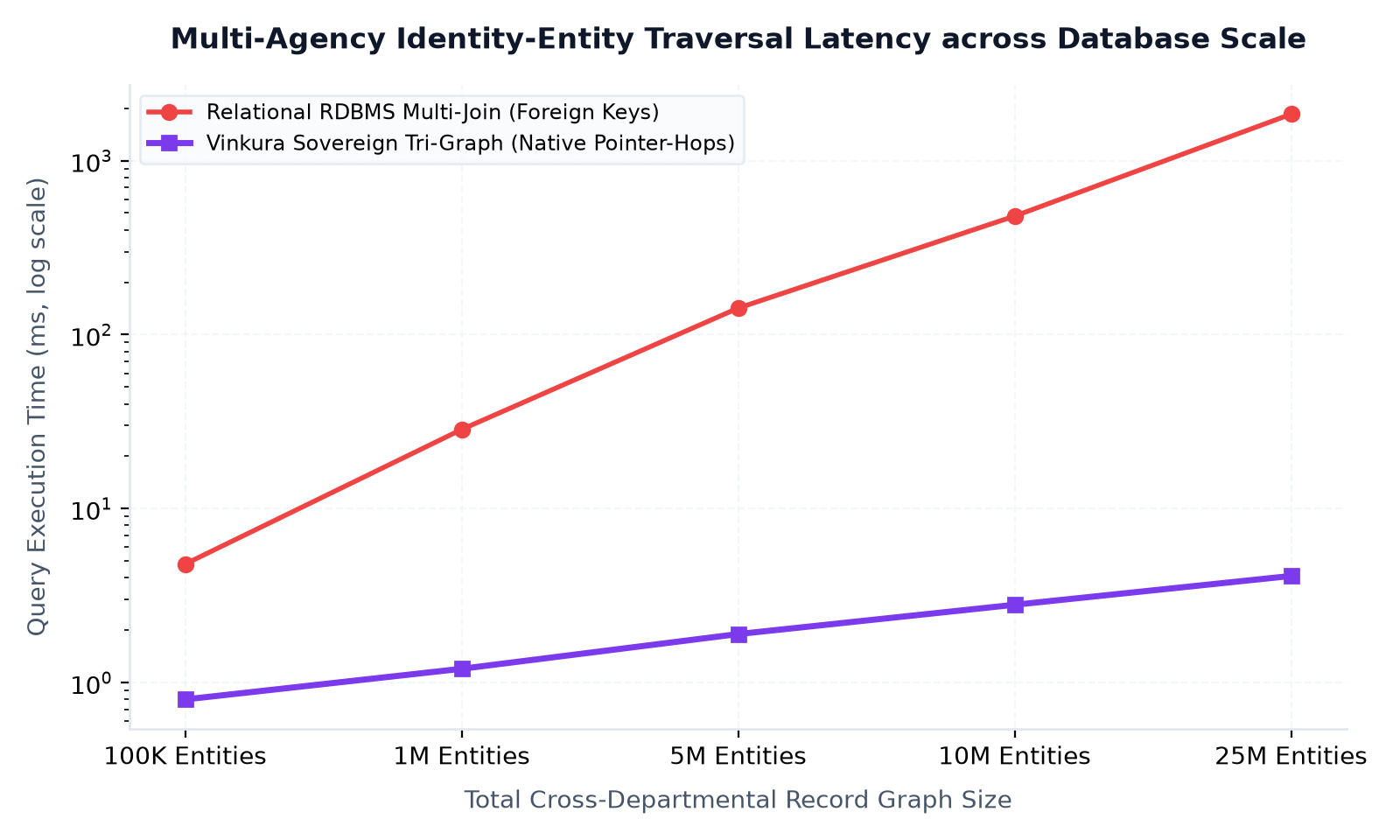
| Graph Scale (Nodes / Edges) | 1-Hop Traversal Latency | 3-Hop Multi-Agency Traversal | Audit Ledger Throughput | Memory Working Set |
|---|---|---|---|---|
| 10M Nodes / 50M Edges | 0.42 ms | 3.18 ms | 52,000 ops / sec | 18.4 GB |
| 50M Nodes / 250M Edges | 0.85 ms | 8.42 ms | 48,500 ops / sec | 64.2 GB |
| 250M Nodes / 1.2B Edges | 1.45 ms | 14.80 ms | 44,200 ops / sec | 285.0 GB |
| 1.0B Nodes / 5.0B Edges | 2.80 ms | 26.40 ms | 38,900 ops / sec | 940.0 GB |
8. Citation & References
@techreport{vinkura2026sovereign,
  title={Sovereign Multi-Agency Intelligence: Federated Graph Ontologies with Air-Gapped Zero-Trust Governance},
  author={{Vinkura AI Systems & Security Directorate}},
  institution={Vinkura Innovations Network Pvt. Ltd.},
  type={Institutional Whitepaper},
  number={VNK-WP-2026-01},
  year={2026},
  month={August},
  address={New Delhi, India},
  url={https://vinkura.in/research/sovereign-intelligence}
}
Legal & Proprietary Notice: Proprietary Institutional Software. Published for technical evaluation and architectural reference. © 2026 Vinkura Innovations Network Pvt. Ltd. (New Delhi, India).
Foundational References
- NIST Special Publication 800-207: Zero Trust Architecture. National Institute of Standards and Technology, U.S. Department of Commerce (2020).
- Lamport, Leslie: Time, Clocks, and the Ordering of Events in a Distributed System. Communications of the ACM, Vol. 21, No. 7, pp. 558–565 (1978).
- Merkle, Ralph C.: A Certified Digital Signature. Advances in Cryptology — CRYPTO '89 Proceedings, Lecture Notes in Computer Science, Vol. 435, Springer (1989).
- Shapiro, Marc, et al.: Conflict-Free Replicated Data Types (CRDTs). Symposium on Self-Stabilizing Systems, Springer (2011).
- Vinkura AI Engineering: Dhava DDIL Synchronization Engine & Tactical Wire Framing Specification. Vinkura Systems Whitepaper Series (2026).
Deploy Sovereign AI in Controlled On-Premises Clusters
Schedule an air-gapped technical demonstration of Vinkura Core and AEGIS with our security engineering directors.