
Field transcription
Time-aligned transcripts from authorised radio, call, interview, and field recordings, kept with the audio they came from.
Move field voice into the official record.
We convert authorised radio traffic, calls, interviews, and spoken field reports into structured, source-linked information. An officer reviews anything that becomes an official record. Voice is the field-audio layer of AEGIS, not a consumer assistant and not an unsupervised transcript dumped into a file.
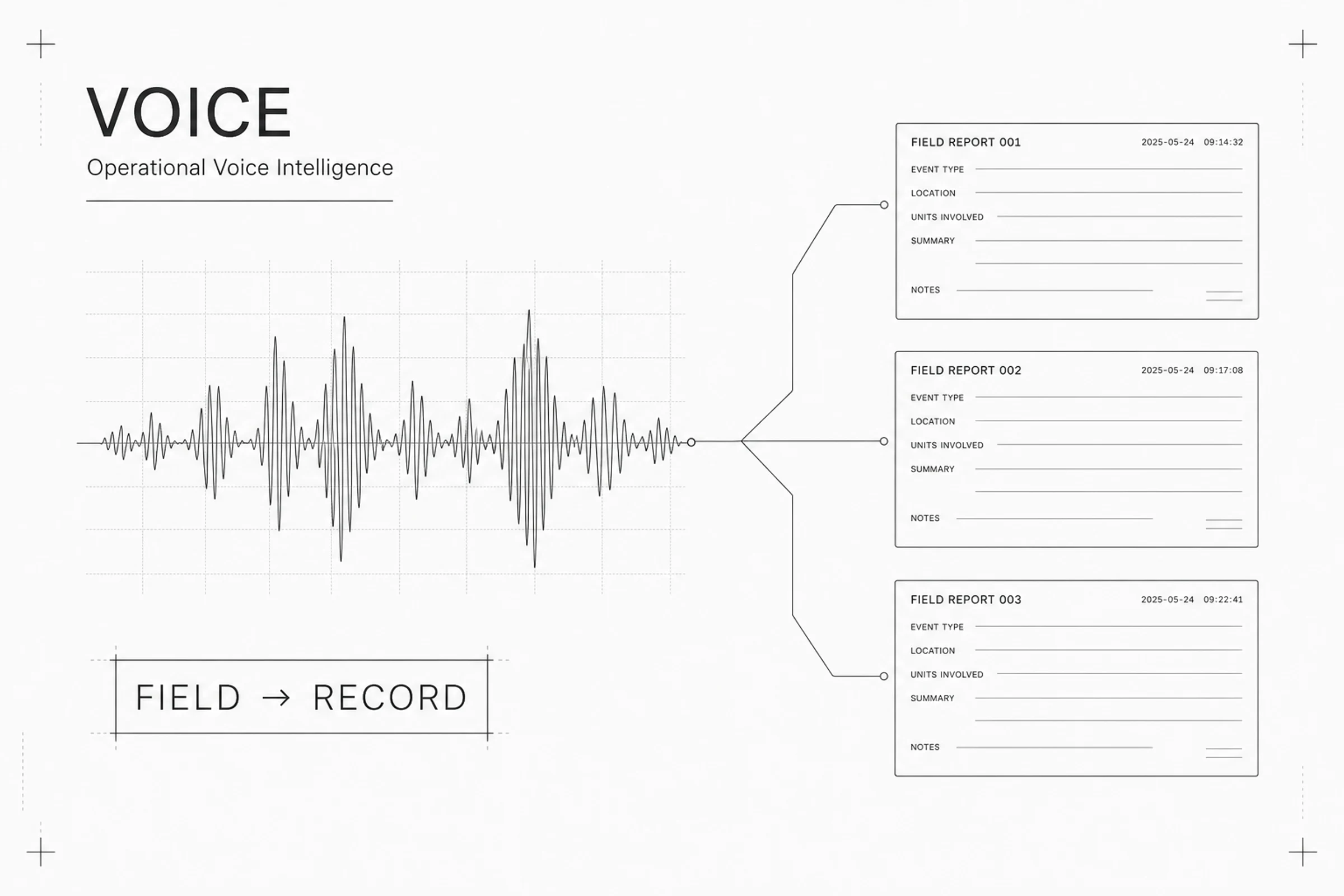
Critical context is often spoken first and documented later. On a radio net, at a gate, in a control room, or on a helpline, the useful sentence happens while hands are occupied and typing is the wrong interface. We built Voice to catch that sentence, structure it, and put it in front of a person before it is treated as a record.
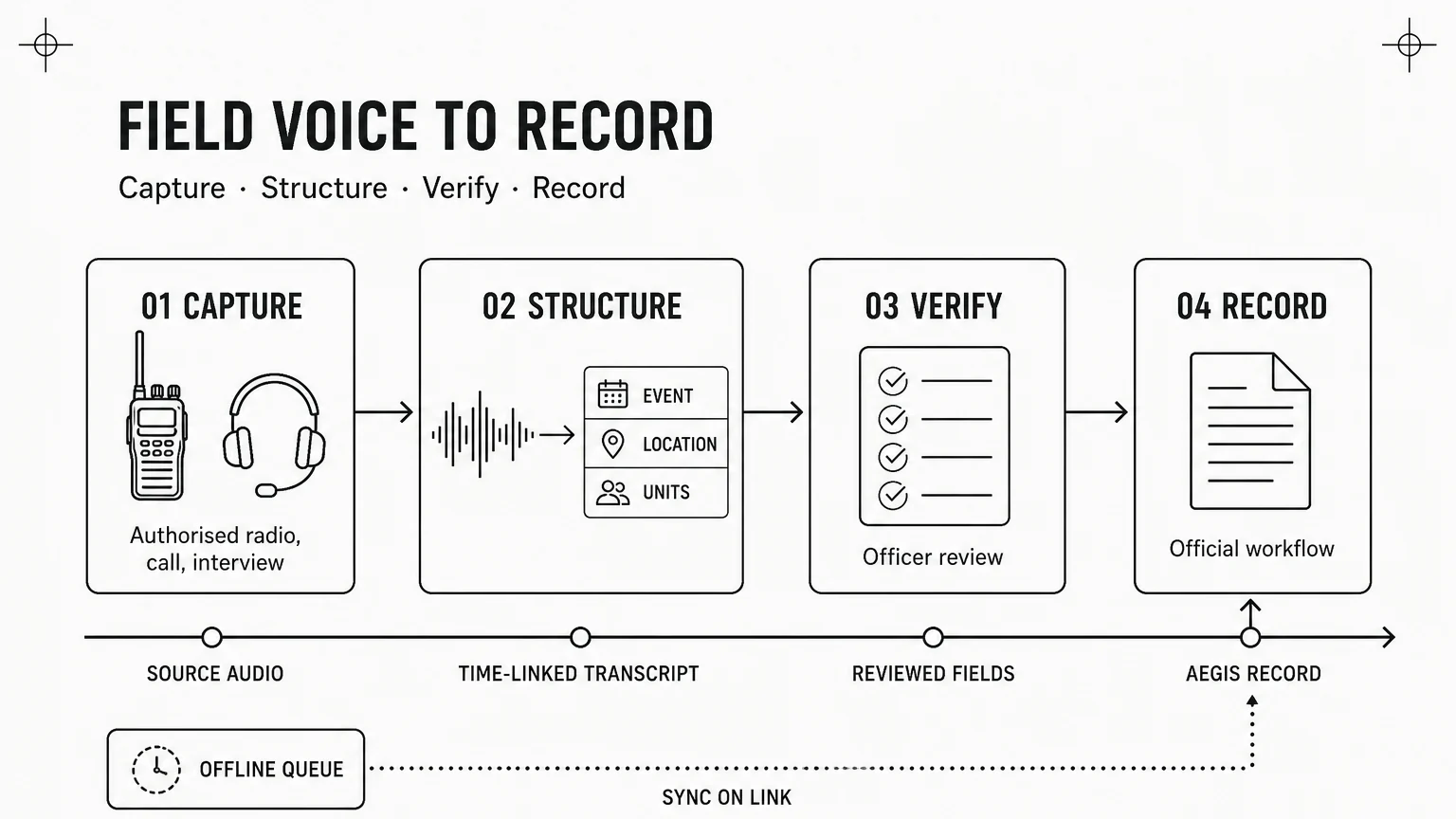
The path is short on purpose. Each stage hands the next one the source it came from, so nothing arrives in the register without a way to check it.
Authorised radio nets, calls, interviews, helplines, and spoken field reports arrive with channel, time, and operational context attached.
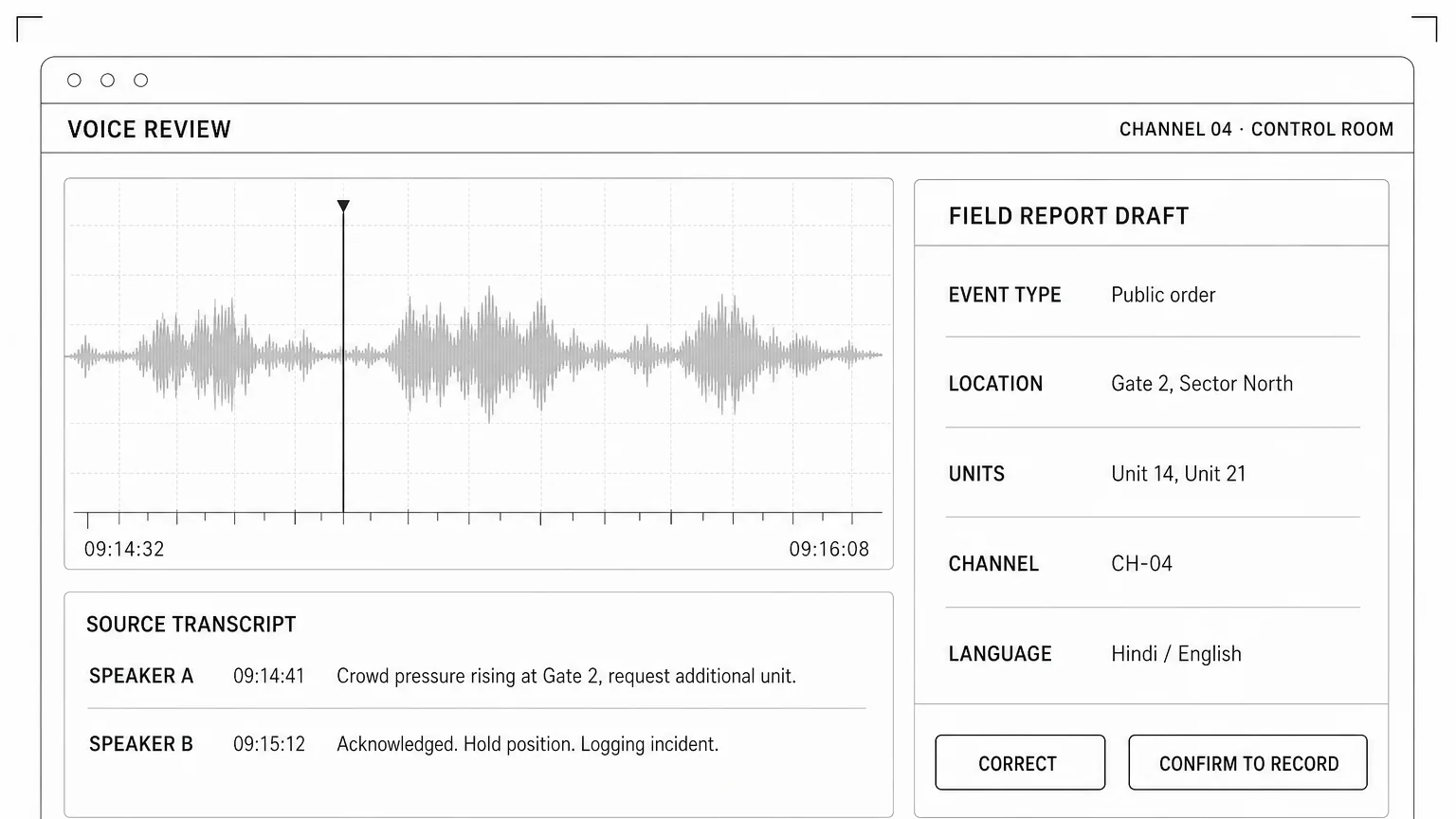
We produce a time-linked transcript and candidate fields — event type, location, units, summary — still tied to the source audio.
Anything that would become an official record is routed to an authorised officer. A transcript is a draft until someone confirms it.
Approved information is committed to the relevant workflow through AEGIS, with the source, the reviewer, and the time retained.
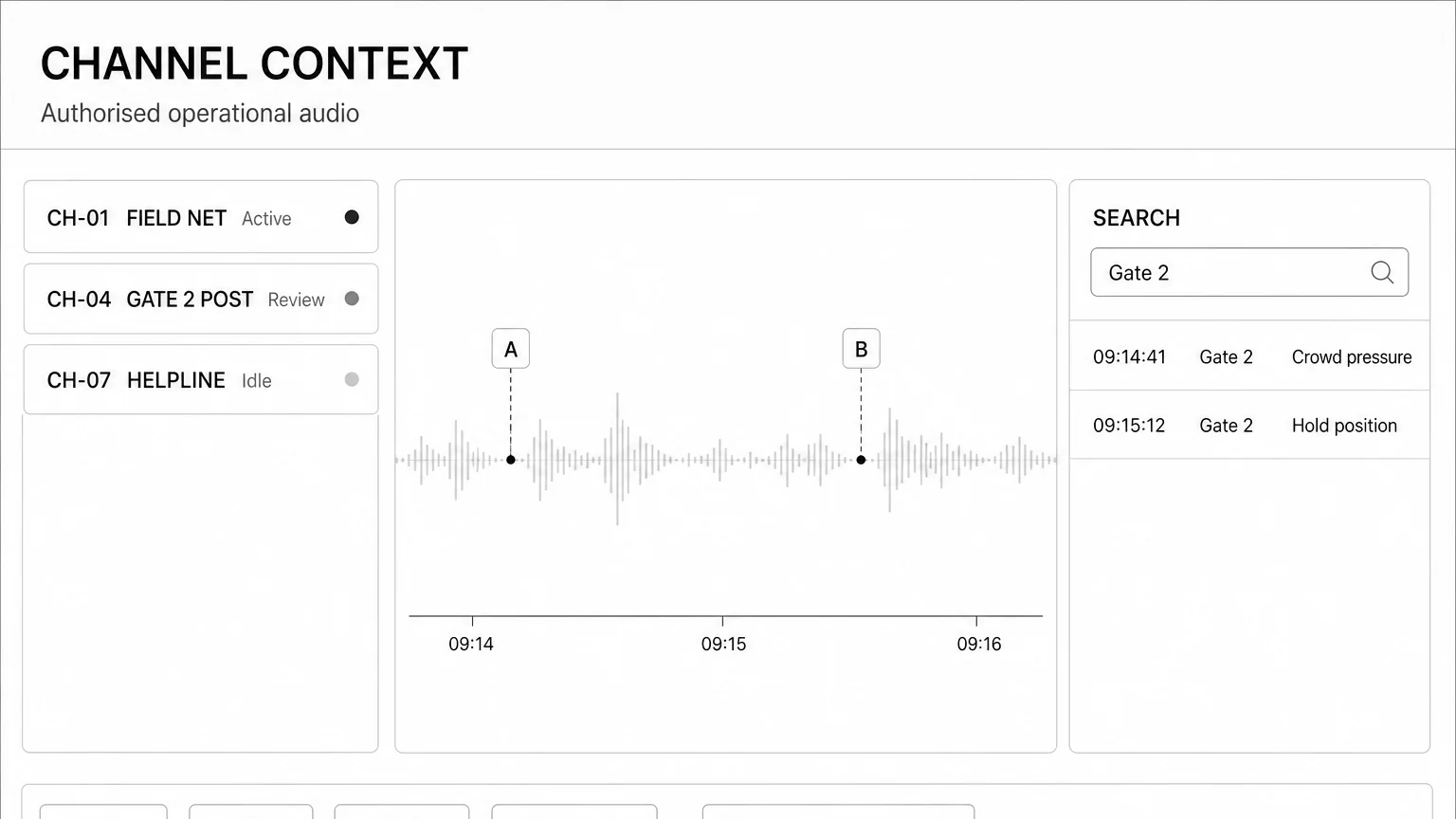
These diagrams show how Voice holds the same spoken interval in the field and at command. They are explanatory pictures, not a live console.
Frontline reporting fails for ordinary reasons: the officer is on the radio, the environment is loud, the language mixes mid-sentence, and the path back to headquarters is intermittent. Voice is built for those conditions, not for a quiet desk.
Time-aligned transcripts from authorised radio, call, interview, and field recordings, kept with the audio they came from.
Operational speech across configured Indian languages and mixed-language conditions, including Hindi–English in a single report.
Reviewed speech converted into incident fields, tasks, summaries, and the inputs an official workflow actually needs.
Channel, time, source, and configured speaker context stay with the interval, so a control room can see who said what, and on which net.
Find relevant intervals across approved audio using words, entities, incidents, and time, instead of scrubbing a recording by ear.
Consequential transcription, extraction, and record creation require review. Voice does not write the official record by itself.
Voice is not a standalone inbox for audio. Identity, permissions, hosting, offline reconciliation, and audit come from AEGIS. Once an officer confirms a report, it can sit in the same command picture as duty, maps, and tasks.
Who may listen, transcribe, search, or confirm a record is set by departmental roles on AEGIS, not by a separate voice login.
A confirmed field report can sit next to the incident, the map in Orbit, the duty in DDMS, and the task in Sentinel — one record, not a side channel.
Audio processing and retention follow the hosting and governance controls of AEGIS: on-premises, sovereign cloud, or a controlled hybrid.
Capture, review, correction, confirmation, and export are written against a user and a role, so a supervisor can reconstruct what entered the record.
We built Voice for the gap between what is said on the net and what later appears in the register. The system holds that interval instead of asking an officer to reconstruct it from memory.
Automated speech is useful only if someone can check it. Every consequential output stays tied to source audio, reviewer action, and the approved workflow.
Field capture can queue locally under constrained connectivity. When a path back to command appears, drafts reconcile through AEGIS instead of disappearing.
Sensitive operational audio can be processed on the authorised device. Raw audio is not treated as something that must leave the environment the department has approved.
Voice does not close an incident, issue an order, or treat an automated transcript as unquestioned fact. It puts source audio, a structured draft, and enough context in front of an authorised officer, and it records what that officer did with it. Retention, redaction, and channel access are set by the department.
Tell us which radio nets, helplines, interview rooms, or field-reporting paths matter, what has to be provable afterwards, and where connectivity actually holds. We will set out how Voice would sit on AEGIS in your environment — command room, field kit, or both — and what review looks like before anything official is written.