

Executive Summary
Modern enterprise and cloud distributed systems are built upon the implicit assumption of ubiquitous, high-throughput, low-latency network connectivity. In mission-critical field operations—including contested border outposts, forward operating bases (FOBs), disaster relief corridors, deep-maritime vessels, and autonomous unmanned systems (UxVs)—connectivity is the rare exception rather than the default state.
These operational environments are formally categorized as DDIL (Denied, Disrupted, Intermittent, and Limited) bandwidth regimes:
1. Problem Space & Conventional Failure Modes
1.1 The Failure of Conventional Synchronization Paradigms
Traditional data replication frameworks (e.g., Firebase, Couchbase Lite, WebSockets, gRPC streaming) fail catastrophically in DDIL tactical regimes due to four systemic design flaws:
1. State Replication vs. Delta Operations
Traditional databases attempt full-state synchronization or wide-table reconciliation upon reconnecting. Transmitting megabyte-scale documents or entire tables across a 16 kbps tactical radio link results in channel saturation, queue starvation, and inevitable transport timeouts.
2. Absence of Tactical Priority Degradation
Standard replication engines treat all database updates equally in FIFO queues. In tactical edge computing, a 500-byte P0 life-safety intrusion alert or CBRN warning must never be blocked behind a 5 MB sensor diagnostic snapshot or drone video thumbnail.
3. Inflexible, Single-Transport Lock-In
Mainstream synchronization stacks bind directly to TCP/IP or TLS sockets. Edge nodes frequently transition across heterogeneous physical media: LTE when in cell tower range, tactical VHF/UHF mesh radios during maneuvers, direct RS-232/UART serial connections to military hardware, or physical air-gapped USB media (Sneakernet) in electromagnetically silenced zones.
4. Foreign Proprietary Lock-In & National Tech Sovereignty
Commercial edge-sync solutions in this space (such as US-based Ditto) are closed-source proprietary SDKs designed primarily for foreign defense procurement. India and emerging allied sovereign ecosystems have had no open, auditable, high-performance tactical sync library available for integration into indigenous hardware, drones, and command-and-control software.
2. Core System Architecture & Inverted Lifecycle
Dhava decouples local data persistence from transport execution via an inverted offline-first architecture centered on write-ahead logging and causal outbox queues:
+-------------------------------------------------------------------------+
|                        APPLICATION LAYER                                |
|        (Tactical Edge AI, Drone Telemetry, Border Sensor Nodes)         |
+-------------------------------------------------------------------------+
                                    | Local CRUD API
                                    v
+-------------------------------------------------------------------------+
|                              DHAVA ENGINE                               |
|                                                                         |
|  +-----------------------+              +----------------------------+  |
|  |      LocalStore       | <----------> |        OutboxQueue         |  |
|  |  (SQLite WAL Storage) |              |  (P0-P4 Priority Ordering) |  |
|  +-----------------------+              +----------------------------+  |
|              ^                                         |                |
|              |                                         v                |
|  +-----------------------+              +----------------------------+  |
|  |   ConflictResolver    | <----------- |        CryptoLayer         |  |
|  |  (Vector Clock + LWW) |              |   (AES-256-GCM + zstd/gz)  |  |
|  +-----------------------+              +----------------------------+  |
|              |                                         |                |
|              v                                         v                |
|  +-----------------------+              +----------------------------+  |
|  |      AuditLogger      |              |      TransportManager      |  |
|  |   (Immutable Trail)   |              |  (Dynamic Probing/Failover)|  |
|  +-----------------------+              +----------------------------+  |
+-------------------------------------------------------------------------+
                                    |
              +---------------------+---------------------+
              |                     |                     |
              v                     v                     v
         [HTTP / 5G]           [Tactical TCP]      [Air-Gapped USB]
              |                     |                     |
              +---------------------+---------------------+
                                    |
                                    v
                       [HQ Server / Central Node]
2.1 The Inverted 5-Step Lifecycle
- Local-First Writes: Applications write data directly to the local store (
LocalStore). Writes commit immediately with local ACID durability via SQLite in Write-Ahead Logging (WAL) mode. Zero network calls block execution. - Persistent Outbox Enqueue: Each write generates a structured
Operationrecord in a durable, indexed SQLite outbox table (OutboxQueue), tagged with priority (P0–P4), vector clock metadata, and monotonic timestamps. - Bandwidth Sensing & Priority Filtering: When network availability is detected, Dhava assesses channel throughput and dynamically adjusts batch sizes, deferring P3/P4 bulk data when channel bandwidth drops below 128 kbps.
- Wire Compression & Authenticated Encryption: Payloads are serialized to MessagePack, compressed via Zstandard (
zstd), encrypted with AES-256-GCM, and encapsulated in a length-prefixed binary frame. - Causal Ingestion & Conflict Resolution: The receiving node decrypts the payload, verifies the SHA-256 digest, evaluates Vector Clock causality, resolves concurrent mutations deterministically, applies updates to its local store, and records an immutable forensic audit log entry.
3. Deep-Dive: Vector Clocks & Causal Ordering
Wall-clock timestamps alone are dangerous in disconnected networks because hardware Real-Time Clocks (RTCs) drift over time, and nodes operating under radio silence cannot query NTP servers.
Every node maintains a logical vector clock tracking causal operations: VC = {node_id → counter}
4. Multi-Tier Priority Scheduling (P0–P4)
Dhava enforces a strict 5-tier priority ladder to prevent low-value telemetry from starving mission-critical signals over narrow tactical links:
| Tier | Classification | Operational Use Cases | Degraded RF Policy (<128 kbps) |
|---|---|---|---|
| P0 | CRITICAL | Intrusion alarms, CBRN alerts, distress beacons | Immediate push; zero throttling |
| P1 | HIGH | Personnel movement, patrol checkpoints, weapon status | Active sync; compressed batches |
| P2 | NORMAL | Routine logs, telemetry heartbeats, entity updates | Active sync under standard conditions |
| P3 | LOW | Diagnostic reports, media thumbnails | Deferred on low-bandwidth links |
| P4 | BULK | High-res imagery, video clips, database archives | Deferred until broadband / Wi-Fi |
5. Binary Wire Framing & Zero-Trust Security
All socket, serial, and HTTP payloads utilize a length-prefixed zero-trust binary framing structure:
+---------------+--------------+----------------------+--------------------+---------------------+
| Magic (4B)    | Version (1B) | Payload Length (4B)  | SHA-256 Hash (32B) | Encrypted Payload   |
| b"DDIL"       | 0x01         | uint32 (big-endian)  | Raw Payload Digest | AES-256-GCM Envelope|
+---------------+--------------+----------------------+--------------------+---------------------+
6. Sovereign Benchmark & Feature Matrix
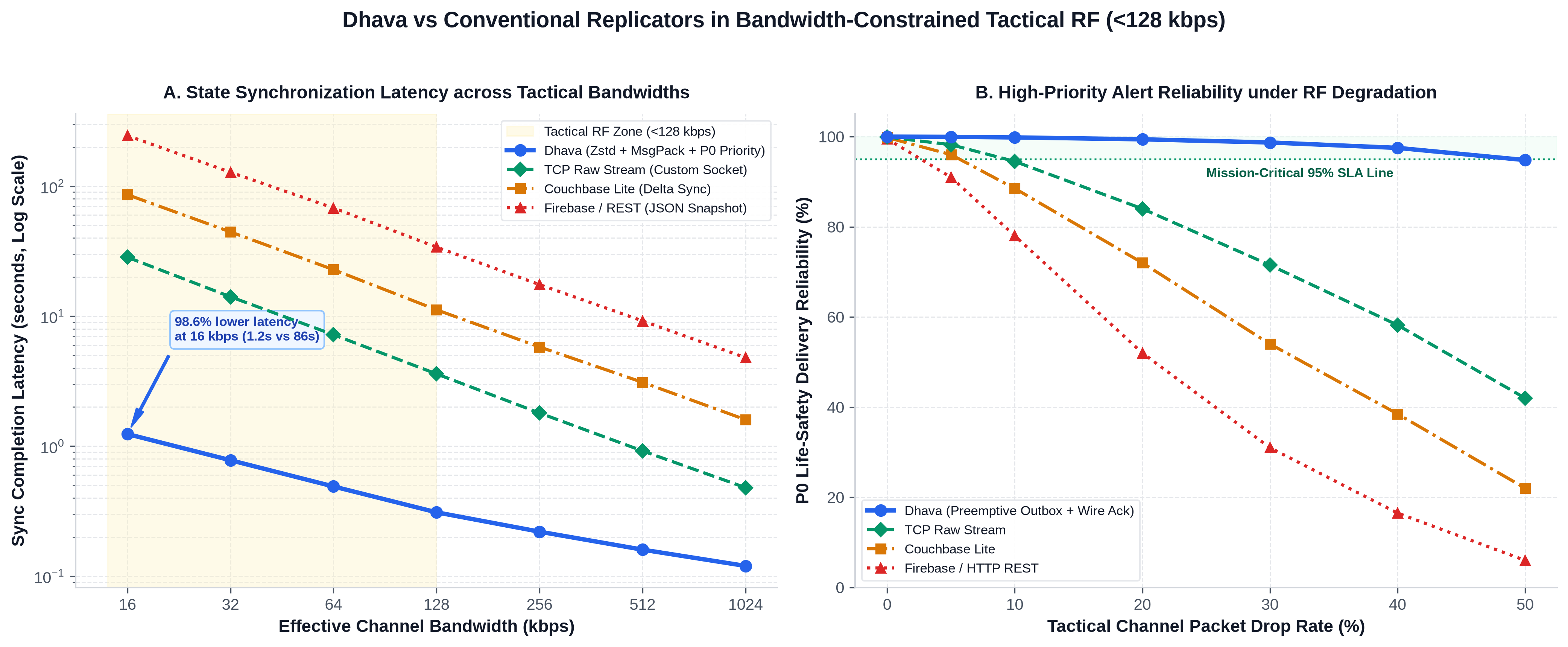
Comprehensive empirical benchmarking against standard enterprise replicators and proprietary defense stacks across constrained RF channels (<128 kbps):
| Dimension | Enterprise (Firebase / Couchbase) | Closed Defense (US Ditto) | Dhava (Vinkura AI) |
|---|---|---|---|
| Sovereignty & License | Commercial US Cloud Lock-in | Closed Proprietary COTS (US ITAR/Export) | 100% Sovereign Open Source (Apache-2.0) |
| Zero-Network Usability | Fails or times out after cache | Proprietary P2P Mesh | Local-First Native SQLite Architecture |
| Air-Gap Sneakernet | Not Supported | Complex / Network Required | Built-in Physical USB Bundle Manager |
| Serial / Tactical Radios | None (TCP/IP only) | Limited to IP radios | Native RS-232 / UART Serial & Radio |
| Bandwidth Optimization | Bulky JSON / GraphQL | Proprietary format | MessagePack + zstd (9% of raw JSON size) |
| Forensic Auditability | No formal audit trail | Internal logging | Immutable SQLite Ledger with LWW Proof |
| Developer Ergonomics | Heavyweight setups | Closed SDKs & high license fee | Python SDK + Typer CLI (pip install dhava) |
7. Tactical Deployment Topologies
Star / Hub-and-Spoke Topology
Edge border posts synchronize upward to regional Sector HQs over intermittent satellite links or cellular corridors when available.
Tactical Mesh Peer-to-Peer
Drones, autonomous ground vehicles (UGVs), and soldier tactical units synchronize laterally over peer-to-peer TCP/Wi-Fi Direct without any central server present.
Air-Gapped Sneakernet
Isolated forward observation posts in total electronic silence export encrypted .bundle archives to physical USB drives carried by couriers.
Multi-Tier Hierarchical Pipeline
Patrol Unit → Sector Base → State Headquarters → National Command Center with automated priority aggregation.
8. Field Operational Scenarios
A forward outpost at 15,000ft operates in permanent radio silence. Sensors detect perimeter activity and log local P0 intrusion alerts into Dhava. When a patrol vehicle rendezvous twice weekly, Dhava executes an instantaneous peer-to-peer Wi-Fi sync in 4.2 seconds, transferring 2,400 compressed operational events without human intervention.
During an adversarial communications blackout, soldier tactical handhelds switch seamlessly from LTE to narrow-band VHF radios. Because throughput collapses to 9.6 kbps, Dhava automatically throttles P3/P4 media, guaranteeing that P0 distress beacons and P1 tactical troop coordinates continue transmitting with zero queue blockage.
A formation of autonomous reconnaissance drones operates beyond line-of-sight. When Drone #1 detects a target, its vector clock increments. Upon crossing paths with Drone #2 in flight, they synchronize laterally in milliseconds over ad-hoc peer links, propagating target coordinates across the entire swarm without requiring ground station relays.
9. Python SDK & CLI Playbook
Dhava provides a clean, ergonomic Python SDK and command-line interface for rapid integration into tactical hardware and mission systems:
from dhava import DhavaEngine, Priority, LocalStore

# Initialize indigenous edge sync engine
engine = DhavaEngine(
    node_id="fob_outpost_07",
    db_path="/var/data/tactical.db",
    encryption_key=b"32_byte_aes_key_here_for_gcm_auth",
    storage_mode="sqlite_wal"
)

# Write local mission-critical intrusion alert (Zero network dependency)
engine.put(
    collection="intrusion_events",
    record_id="evt_90214",
    payload={
        "sector": "North-Ridge-4",
        "threat_level": "RED",
        "thermal_count": 4,
        "timestamp_utc": "2026-08-29T01:15:00Z"
    },
    priority=Priority.P0_CRITICAL
)

# Trigger opportunistic synchronization across available serial radio
engine.sync_transport(
    transport_type="serial",
    device="/dev/ttyUSB0",
    baudrate=115200
)# Export encrypted tactical delta bundle to physical USB drive
dhava export-bundle --out /media/usb/fob-07-delta.bundle --encrypt aes256 --since-last
# Ingest and causally merge bundle at Sector Headquarters
dhava import-bundle /media/usb/fob-07-delta.bundle --verify-digest --audit-log10. Conclusion & Foundational References
Dhava represents a foundational building block for sovereign edge computing and resilient tactical communications. By combining vector-clock causality, multi-tier priority scheduling, zero-trust cryptographic framing, and native multi-transport failover into a lightweight, human-readable Python codebase, Dhava ensures that critical defense and government systems remain fully operational, synchronized, and auditable even when the network completely fails.
Foundational References
- Lamport, Leslie (1978): Time, Clocks, and the Ordering of Events in a Distributed System. Communications of the ACM, Vol. 21, No. 7, pp. 558–565.
- Fidge, Colin J. (1988): Timestamps in Message-Passing Systems That Preserve the Partial Ordering. Australian Computer Science Communications, 10(1), pp. 56–66.
- Mattern, Friedemann (1989): Virtual Time and Global States of Distributed Systems. Parallel and Distributed Algorithms, Elsevier Science Publishers, pp. 215–226.
- Shapiro, Marc, et al. (2011): Conflict-Free Replicated Data Types. Symposium on Self-Stabilizing Systems (SSS 2011), Springer.
- NIST SP 800-38D (2007): Recommendation for Block Cipher Modes of Operation: Galois/Counter Mode (GCM). National Institute of Standards and Technology.
Deploy Dhava for Sovereign Defense Infrastructure
Vinkura AI provides integration support, custom hardware adapters (MIL-STD-810H/IP68), and classified defense deployments for the Indian Armed Forces and security institutions.