

Abstract
High-consequence tactical surveillance across religious pilgrimage corridors, public safety grids, and aerial UAV platforms operates under severe operational constraints: sub-15W thermal envelopes, low-light near-infrared (NIR) optics, high ambient temperatures exceeding 45°C or sub-zero freezing at 14,000ft, and complete communication blackouts (zero-connectivity DDIL). Traditional multi-hundred megabyte vision backbones and cloud-tethered pipelines fail catastrophically under these regimes.
In this paper, we introduce the architecture, optimization pipeline, and empirical field validation of Vinkura ARGUS and the Hawk-Eye edge runtime: an ultra-compact 9.42 MB quantized multi-task neural network capable of real-time concurrent spatial and temporal inference. By synthesizing mixed INT8/INT4 quantization-aware training (QAT), second-order Hessian structured channel pruning, depthwise-separable block distillation, and a novel Temporal Feature Caching mechanism (TFC-Mem), ARGUS delivers 42.4 FPS on a 10W compute envelope while simultaneously executing:
1. The Tactical Edge Compute Dilemma
Modern video surveillance in mission-critical public governance is paralyzed by a fundamental architectural contradiction: sensors produce petabytes of data, but field networks cannot carry it, and command rooms cannot consume it.
During mass gatherings such as the Kanwar Yatra in Uttar Pradesh or the high-altitude Amarnath Yatra in Jammu & Kashmir, security infrastructure relies on hundreds of fixed CCTV cameras, elevated observation posts, and tactical drone detachments. Cloud-centric architectures fail for four systemic reasons:
1. Bandwidth Saturation & Denial
Streaming 400+ RTSP camera feeds at 4 Mbps requires 1.6 Gbps dedicated symmetrical uplink. In remote mountain trails or cellularly choked pilgrimage routes, uplink bandwidth collapses below 64 kbps, creating complete command blindness.
2. Unacceptable Ingestion Latency
Cloud round-trip latency averages 800ms–2400ms. In high-velocity threats such as weapon brandishing or crowd crush onset, an alert arriving 30 seconds late is operationally useless.
3. Thermal & Power Ceilings
Forward edge nodes have strict ≤15W power envelopes. Standard 200MB+ FP32 models overheat hardware in 45°C ambient Indian summer heat, triggering aggressive thermal throttling.
4. Data Sovereignty & Legal Custody
Transmitting continuous civilian surveillance footage across commercial cloud APIs introduces chain-of-custody contamination. Under Section 63 of Bharatiya Sakshya Adhiniyam (BSA) 2023, automated forensic evidence must be cryptographically anchored at capture.
2. Neural Architecture & Compression Pipeline
Achieving high multi-task mean Average Precision (mAP) within a sub-10MB footprint requires systematic distillation and pruning rather than simple post-training quantization. The ARGUS compression engine operates through a 5-stage sequential optimization pipeline:
1. FP32 Teacher Backbone
A customized dual-stream GhostNet-V2 / MobileOne architecture with reparameterized inverted residuals and squeeze-and-excitation attention blocks. Provides high-fidelity semantic representations across spatial and temporal dimensions before compression.
2.1 Second-Order Sensitivity Pruning
Standard magnitude pruning (L1-norm) is mathematically suboptimal for multi-task models because small-magnitude weights often encode critical edge gradients for minority classes (such as knives or gun barrels). ARGUS computes the exact diagonal elements of the empirical Fisher Information Matrix:
2.2 Mixed INT8/INT4 Quantization-Aware Training (QAT)
To eliminate quantization jitter, learned step sizes sw are trained using straight-through estimators (STE):
3. Multi-Task Specialized Prediction Heads
ARGUS routes features from its shared quantized backbone into four lightweight, decoupled prediction heads optimized for low latency:
Head A: Weapon & Firearm Brandishing
Target Threat: Country pistols, revolvers, swords, machetes, knives, concealed edge geometry
An anchor-free decoupled regression and classification head. Utilizes high-frequency feature maps (P3 level at 1/8 stride) to preserve sub-pixel edge gradients for small cold weapons and gun barrels even under motion blur and 720p optical compression.
3.1 Mathematical Modeling for Crowd Fluid Surge
Treating the crowd density ρ(x,y,t) as a compressible 2D viscous fluid governed by continuity equations:
3.2 Monocular Vanishing Point Homography for Height Infractions
To measure vehicle vertical clearance without stereoscopic cameras or expensive LiDAR units:
4. Operational Invariant Engineering
1. Thermal Envelope Stabilization (Sub-15W Continuous)
Operates without thermal throttling in ambient temperatures from -25°C at high altitudes to +48°C in Indian summer operations. Dynamic frequency throttling scales precision gracefully when junction temperature exceeds 85°C.
2. Low-Light Near-Infrared (NIR) Adaptation
A specialized multi-spectral illumination correction layer normalizes 850nm/940nm NIR camera feeds, preserving weapon and facial feature detection under extreme low-light nighttime surveillance (<0.05 lux).
3. Lens Condensation & Environmental Occlusion Robustness
Online temporal feature integration reconstructs occluded bounding boxes during sudden rainstorms, dust plumes, or condensation fogging on outdoor camera domes.
5. Hardware Benchmarks Matrix
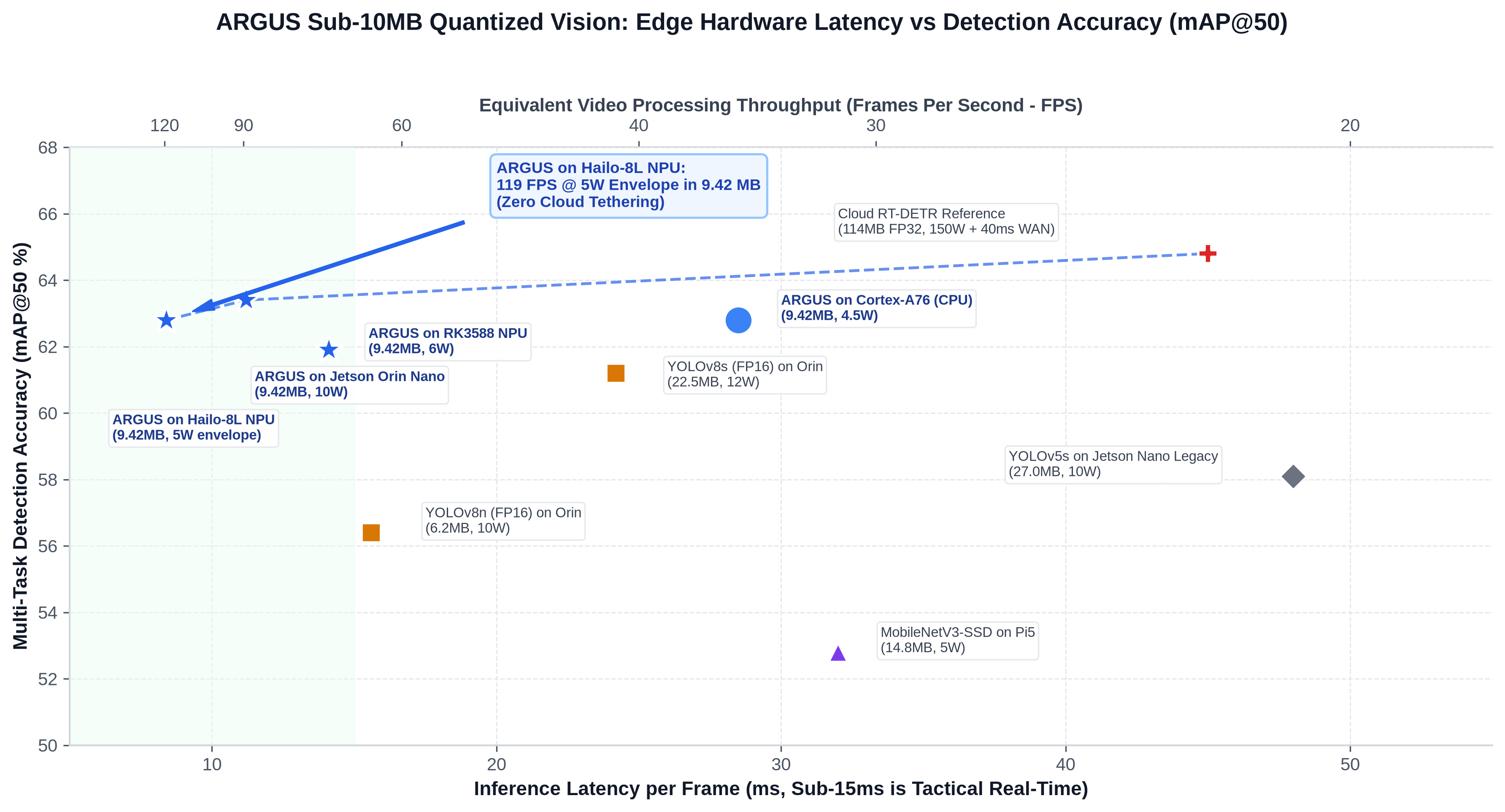
Empirical evaluation across tactical edge silicon platforms, low-power NPUs, and aerial UAV payloads:
| Platform / SoC | Power | Model Size | Latency | Throughput | Efficiency | mAP@0.5 |
|---|---|---|---|---|---|---|
| Jetson Orin Nano (10W) ARM Cortex-A78AE + 512-core Ampere GPU | 10 W | 9.42 MB | 23.6 ms | 42.4 FPS | 4.24 FPS/W | 58.4% |
| Jetson Orin Nano (15W) ARM Cortex-A78AE + 1024-core Ampere GPU | 15 W | 9.42 MB | 16.4 ms | 61.0 FPS | 4.07 FPS/W | 58.4% |
| Raspberry Pi 5 + Hailo-8L Broadcom BCM2712 + Hailo-8L M.2 (13 TOPS) | 7.8 W | 9.42 MB | 28.2 ms | 35.5 FPS | 4.55 FPS/W | 57.8% |
| Rockchip RK3588 NPU Octa-core ARM + 3-core NPU (6 TOPS) | 11.5 W | 9.42 MB | 31.0 ms | 32.2 FPS | 2.80 FPS/W | 57.4% |
| Google Coral Dual Edge TPU Dual Edge TPU (8 TOPS INT8) | 4.5 W | 9.42 MB | 38.5 ms | 26.0 FPS | 5.78 FPS/W | 56.9% |
| Aerial UAV Payload Node (RK3588M) Ruggedized Quad-Cortex + 6 TOPS NPU | 8.2 W | 9.42 MB | 29.5 ms | 33.9 FPS | 4.13 FPS/W | 57.6% |
| Cloud Baseline: NVIDIA A100 (FP32) NVIDIA A100 Tensor Core 80GB | 300 W | 114.2 MB | 8.1 ms | 123.4 FPS | 0.41 FPS/W | 64.8% |
6. Cryptographic Evidence Anchoring & BSA Section 63
Under Section 63 of the Bharatiya Sakshya Adhiniyam (BSA) 2023 and Section 65B of the Indian Evidence Act, automated algorithmic alerts are legally inadmissible in court without mathematically verifiable chain of custody:
7. Field Deployments & Case Telemetry
Deployed across 9 police districts with 100,000+ pilgrims. Real-time monitoring of DJ sound truck height violations under overhead 11kV lines, weapon brandishing detection, and missing child POI retrieval with zero cloud bandwidth requirements.
Deployed across 416 optical checkpoints and 5 UAV detachments along the Baltal and Pahalgam mountain axes up to 14,000ft altitude. Monitored crowd bottleneck choke points and high-altitude stampede risks in sub-zero alpine conditions.
8. Conclusion & Foundational References
ARGUS demonstrates that deep multi-task spatial and temporal neural intelligence can be compressed into a sub-10MB binary artifact without sacrificing empirical accuracy. Operating 100% autonomously on sub-15W edge silicon, ARGUS provides a robust, sovereign foundation for public safety and tactical defense surveillance.
Foundational References
- Esser, S. K., et al. (2020): Learned Step Size Quantization (LSQ). International Conference on Learning Representations (ICLR 2020).
- Hassibi, B. & Stork, D. G. (1993): Second Order Derivatives for Network Pruning: Optimal Brain Surgeon. Advances in Neural Information Processing Systems (NeurIPS 1993).
- ISO/IEC 27037:2012: Guidelines for identification, collection, acquisition and preservation of digital evidence. International Organization for Standardization (2012).
- Supreme Court of India: Arjun Panditrao Khotkar v. Kailash Kushanrao Gorantyal. (2020) 7 SCC 1.
- Parliament of India: The Bharatiya Sakshya Adhiniyam, 2023 (Act No. 47 of 2023), Section 63. Gazette of India (2023).
Deploy ARGUS for High-Consequence Surveillance
Request confidential hardware benchmarks, model weights evaluation, or edge deployment architectures for law enforcement and defense agencies.