
Most operations centers inherit their feeds rather than design them. Duty posture lives in one system, field reports in another, evidence and case status somewhere else again. Analysts spend the shift matching names, places, and timestamps by hand — which means the mismatches that matter, like crowd pressure building in a thinly covered sector or an overdue forensic return, only become visible after the moment to act has passed.
System record · Command · Situational awareness
Operations center · Command intelligence
Sentinel Operations Center
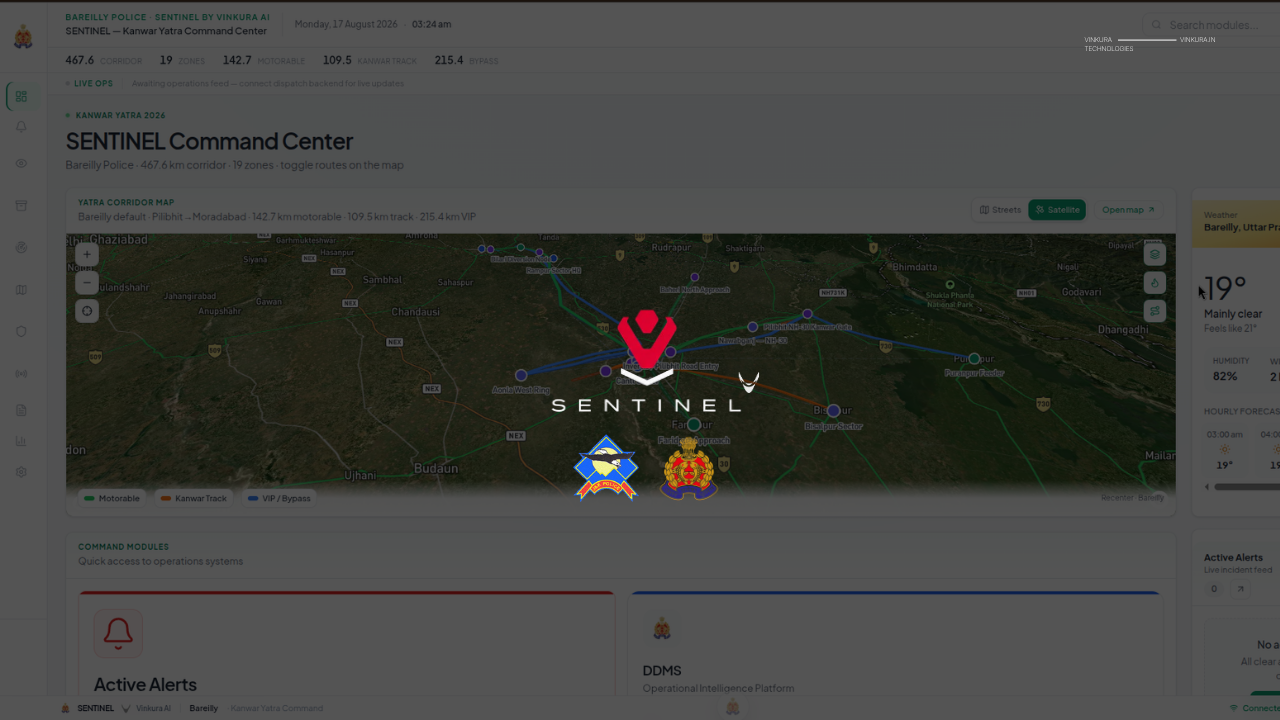
Sentinel is Vinkura’s command layer. It takes what an operations center already runs — duty posture, field reporting, identity, evidence and case status — and turns it into one picture a commander can act on.
Sentinel: Operational Intelligence & Command ↗- Built by
- Vinkura
- System
- Sentinel — operational intelligence and command
- Runs on
- AEGIS shared platform module
- Used for
- Mission management, live context, alerting, after-action review
01CHALLENGE
02WHAT WE BUILT
One mission picture
Signals from personnel, identity, field, and case systems are normalised into a common schema, so the command view is assembled by the system instead of by an analyst with three windows open.
Entity resolution
The same person, place, or case referenced differently across modules is linked into one entity, with the underlying records still visible for review.
Live context and alerts
Sentinel watches for anomalies that only appear when systems are read together — a duty gap against rising activity in the same sector — and raises them as reviewable command context.
Auditable command
Each alert keeps the source data as it stood at decision time, so a reviewer can see exactly how it was produced and what the commander was looking at.
03IN THE FIELD
In use, Sentinel gives the duty officer one surface: the current mission picture, the entities involved, and a short list of things that need a decision. Alerts arrive with the context that produced them, so the first question — why am I seeing this? — is answered on the same screen. The commander acts, the action returns to the field workflow, and the response remains attached to the event that prompted it.
04WHY IT IS DIFFERENT
Sentinel is built above the operation, not beside it. It fuses the identity layer from Pehchan, personnel posture from DDMS, field reporting from Trinetra, and evidence state from e-Maalkhana without hiding their source records. Agencies can run the command layer on sovereign or on-prem infrastructure. Every correlation is inspectable, every alert carries provenance, and every command action is preserved for after-action review.
05IMPACT
Sentinel replaces analyst-driven window switching with a shared command picture. It makes cross-system mismatches visible while there is still time to respond and gives the next shift the same institutional memory. The result is faster orientation, clearer accountability, and a control room that can close the loop with field teams instead of merely watching them.
06COVERAGE
Supporting coverage.
- The Hindustan WiresIndia's answer to operational intelligence: How Vinkura is building a sovereign AI platform ↗
Profile of Vinkura covering Sentinel as the command-intelligence layer of the platform.
07CONNECTED SYSTEMS
08DEPLOYMENT BRIEFING
Talk to our team about running this system in your district, unit, or command.
Request a Briefing